
Let’s put aside the usual corporate press releases and focus on what’s really happening. Until recently, enterprise companies wanting to use advanced language models at scale faced major challenges. They had to manage a messy mix of technologies, spend heavily on custom cloud setups, and worry nonstop about data compliance.
Now, those problems are gone. The tech industry is making big changes in how advanced systems are deployed. As we explained in OpenAI Meets AWS: Big Tech Simply Made It Incredibly Easy for Companies to Use GPT-5.5, this new partnership connects powerful AI with established cloud platforms. What was once a complicated and risky project is now a simple, plug-and-play solution for businesses.
But as it gets easier to use these technologies, a bigger and more complex challenge is happening out of public view: deciding who will set the rules for this new frontier.
The days of letting advanced models operate without rules are ending. As artificial general intelligence (AGI) becomes more real, tech companies and regulators are debating an important question: Who will decide the rules for this powerful technology?
The Fractured Playground of State-Level Laws
At the moment, federal lawmakers are trying to catch up. Since Congress has been slow to regulate technology, individual states have started creating their own laws.
There is now a surge of new state-level safety laws, such as California’s SB 53, New York’s RAISE Act, and Illinois’s SB 315. These laws are serious. They require strict transparency, public reporting of risk evaluations, and strong financial and legal consequences for developers who fail to secure their systems.
While these state laws help improve public safety, they also create significant problems for the tech industry by causing widespread fragmentation.
If each state creates its own detailed and conflicting rules, the AI industry could slow down due to excessive local regulation. The tech sector needs one strong national framework that can keep up with how quickly technology changes.
The Three-Part Blueprint for Federal Oversight
To avoid complicated compliance issues and protect national security, OpenAI recently shared a broad public policy plan and a detailed federal safety proposal. The main idea is to use what states agree on and turn it into a single federal system.
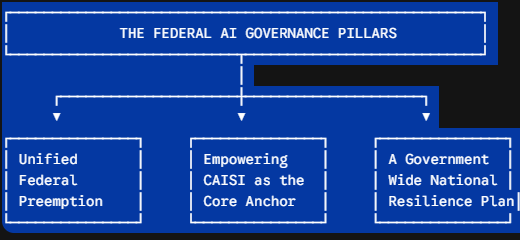
This strategy is built on three main ideas
1. Unified Federal Preemption
The federal government should create a comprehensive framework that combines the best elements of openness with whistleblower protections from state laws, replacing them with a single set of rules. This way, all developers follow the same requirements, and there is no confusion from different state rules.
2. Supercharging CAISI
The Center for AI Standards and Innovation (CAISI) should become the main federal group for AI safety. In this role, CAISI would not just advise but also review the most advanced AI models, manage independent assessments, and closely monitor for signs of recursive self-improvement (RSI), in which AI can improve itself without external help.
3. A Holistic Resilience Plan
AI safety at the highest level is a national security concern. Advanced models can pose real risks, including cyberattacks and threats involving chemicals, biological agents, radiation, or nuclear materials. The plan suggests a government-wide approach, with strong partnerships between industry and defense to build better cyber defenses and protect important infrastructure.
Beyond National Security: The New Social Contract
Real democratization means making sure advanced technology benefits everyone, not just a few powerful groups. Recent user data show that these platforms are used equally by men and women across different ages and by more people earning under $100,000 than those earning over $100,000.
To keep these economic benefits and reduce risks, policy needs to go beyond technical details and focus on how people are affected every day:
- Youth Safety and Protection: We need clear, risk-based rules for teens. This means using privacy-friendly age checks, required parental controls, and built-in safety features that block damaging content, manipulative behavior, and fake images.
- Deepfakes and Content Authenticity: As digital fakes become more common, we should require open-source tracking tools, such as C2PA standards, in all generated media so people can quickly check where it came from. We also need strong laws to make non-consensual intimate images and fake political videos illegal.
- The Economic Safety Net: As AI changes jobs, regular training programs are not enough. Funding should go to local AI centers and partnerships with labor groups. In the long term, governments need to plan for larger changes, such as portable benefits, updated taxes, and flexible support systems for workers transitioning into new roles.
The Up-to-date Governance Checklist
Whether you lead a federal agency or a business, managing advanced technology requires a careful, proactive approach. Use these three steps to guide your strategy:
- Audit for Hidden Vulnerabilities: Don’t wait for regulators to act. Check your AI systems now for security gaps, data leaks, and dependency risks. Make safety a basic part of your infrastructure, not just a legal requirement.
- Demand Content Authenticity: If your organization makes or shares digital media, add cryptographic tracking to your content right away. Protect your brand by ensuring your audience can always verify that your digital content is real.
- Invest Heavily in AI Literacy: The best defense against algorithmic risk is an educated workforce. Establish continuity. Invest heavily in AI Literacy: The best way to reduce AI risks is to have a well-informed team. Set up ongoing training and ensure your staff has time to learn to use advanced automation safely and thoughtfully. Are you taking today to ensure your technology stays safe, transparent, and completely under human control?